Accurate information about river temperatures is essential for managing energy and water resources across the United States. Water temperature and availability affect the operation of thermoelectric power plants such as nuclear and natural gas facilities, which generate more than 70% of the nation’s electricity. River temperatures also influence hydropower performance, aquatic ecosystems, and water quality. However, most U.S. waterways lack monitoring gauges to automatically track changes in temperature.
Researchers at the U.S. Department of Energy’s Oak Ridge National Laboratory (ORNL) have developed a new modeling framework called River Temperature Time Series for Hydrothermal Modeling and Analysis (RiTHyMs) that leverages artificial intelligence to estimate daily river temperatures across the continental United States—even in unmonitored watersheds.
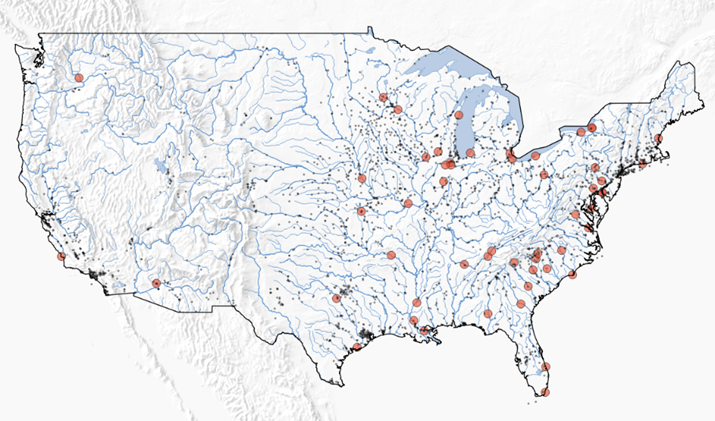
The RiTHyMs framework combines machine learning with hydrological data gathered from nine years of daily observations from 300 U.S. Geological Survey river gauges alongside ORNL-developed watershed datasets available through the HydroSource platform. Together, these inputs capture how weather patterns, watershed conditions, and streamflow influence river temperatures over time. The model achieved a median prediction error of approximately 1.1°C, comparable to conventional models while requiring far less time and resources to build and maintain.
Key Capabilities of the RiTHyMs Model
The RiTHyMs framework provides a new approach for analyzing river temperature conditions at regional and national scales. Key capabilities include:
- Nationwide coverage: Capable of generating daily river temperature estimates across all 2.7 million river reaches in the continental United States.
- Reliable predictions during extreme heat: Maintains accuracy during high-temperature events, when grid reliability and compliance with water withdrawal regulations are critical.
- Improved predictions using upstream signals: Incorporates data from upstream river segments to strengthen temperature estimates in larger river systems.
- Broad data sourcing: Uses robust input data to enable consistent predictions in disparate climates and ungauged watersheds.
Supporting Energy and Water Resource Planning
River temperature projections can help inform power plant cooling operations, infrastructure planning, and water resource management, particularly in regions where monitoring data are limited. The model also supports research on hydropower operations, water quality conditions, and ecosystem impacts.
Researchers are continuing to enhance the model’s capabilities, including with improved prediction over mountainous watersheds and groundwater-dominated rivers. The team is also applying the model to improve river and reservoir temperature simulations in heavily regulated rivers, while creating new web tools to make the model predictions available to reservoir operators nationwide.