Citation
Md Abu Bakar Siddik, Sean Turner and Shih-Chieh Kao. 2026. RiTHyMs: Foundational Dataset for Developing Large-Sample Stream Temperature Models in the Conterminous United States, Version 1.1. HydroSource. Oak Ridge National Laboratory, Oak Ridge, Tennessee, USA. DOI: 10.21951/RiTHyMs_V1/17239901
Spatial Extent
- N:
- 50.1399
- S:
- 23.8331
- E:
- -64.7754
- W:
- -127.7051
Temporal Range
1980-10-01 to 2019-09-30
Overview
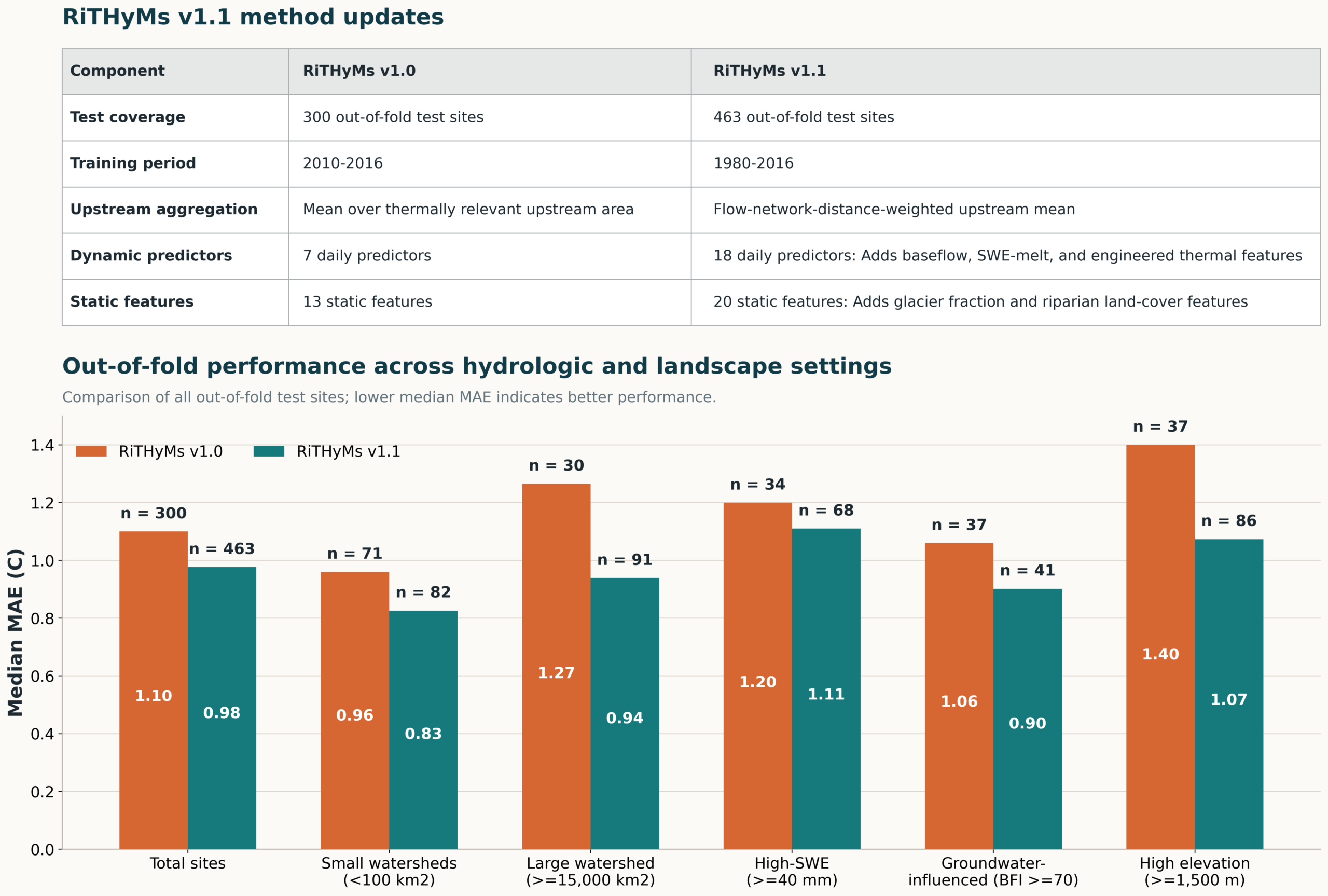
RiTHyMs v1.1 is a reproducible large-sample deep-learning framework for estimating daily stream temperature at unregulated river reaches across the conterminous United States (CONUS). It builds on RiTHyMs v1, which established a transferable LSTM approach using nationally available meteorological, hydrologic, and geospatial inputs to extend daily stream-temperature prediction to ungauged reaches. RiTHyMs v1.1 uses 1980 through 2016 for model fitting and evaluates out-of-fold predictions for water years 2017-2019 at 463 test sites. Compared with RiTHyMs v1.0, v1.1 uses flow-network-distance weighting of Daymet grid cells to aggregate thermally relevant upstream meteorological forcings. It combines atmospheric and hydrologic daily predictors, including air temperature, precipitation, solar radiation, wind, flow, baseflow, soil moisture, and snow-water-equivalent conditions, with physiographic, land-cover, glacier, and riparian static features. The dataset supports reproducible model training and independent out-of-fold evaluation at site-disjoint test basins. It contains three .zip files described below
RiTHyMs_v1-1_runs.zip: Model outputs from fixed-100-epoch, 10-fold cross-validation, including observed and predicted daily stream temperatures and test performance metrics for water years 2017-2019.
RiTHyMs_v1-1_inputs.zip: Formatted static and dynamic predictor datasets, observed daily stream temperatures, selected-site information, and supporting geospatial reference data used to train and evaluate RiTHyMs v1.1. The archive contains complete processed inputs for 514 study sites; the included scripts can reproduce feature extraction using public Daymet and Dayflow sources.
RiTHyMs_v1-1_code.zip: Code used to generate RiTHyMs v1.1. Detailed instructions and data structure are available at https://code.ornl.gov/u96/rithyms-v1.1.
Methodology
Stream-temperature sites across CONUS were selected based on daily-record completeness and suitability for model training and independent testing. Daily meteorological predictors were obtained from Daymet and streamflow from Dayflow for NHDPlusV2 reaches. For each site, the upstream watershed was delineated from the NHDPlusV2 flow network. Daymet grid cells were intersected with watershed polygons, including partial boundary cells, and daily values were aggregated using flow-network-distance weights to emphasize conditions nearer the outlet. Static catchment features, including topography, land cover, riparian conditions, glacier attributes, and long-term climatic characteristics, were compiled across each upstream network. Within each site-disjoint, cluster-stratified fold, model fitting used training basins from 1980 through 2016. Validation and test basins were evaluated for water year 2017 to 2019, and no basin appeared in more than one role within a fold. A Long Short-Term Memory (LSTM) neural network integrated 365-day sequences of dynamic meteorological and hydrologic predictors with static watershed attributes to predict daily stream temperature in degrees Celsius. Models used fixed 100-epoch MSE training; predictors were normalized from training basins only, and missing temperature observations were excluded from loss and performance calculations.
Science Themes
Related Records
Foundational Dataset for Developing Large-Sample Stream Temperature Models in the Conterminous United States, Version 1.0
This dataset provides inputs, evaluation results, and trained weights from a large-sample Long Short-Term Memory (LSTM) model designed to predict daily stream temperatures across unregulated river reaches in the conterminous United States (CONUS).
View Dataset